Roughty: Evaluating a Textured Display Font for Adventure and Playful Design
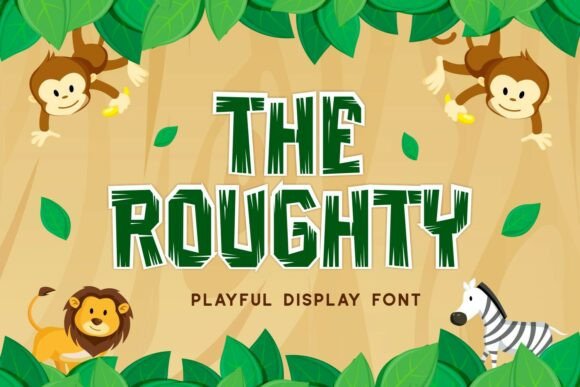
Selecting the right typeface for thematic projects often requires balancing aesthetic appeal with functional legibility. Roughty is a decorative display font designed specifically to capture the spirit of exploration through a distinct woodcut aesthetic. Unlike standard sans-serif or serif families that prioritize neutrality, Roughty embraces imperfection. Its rough, textured appearance and jagged edges mimic traditional hand-carved printing blocks, offering a rugged and slightly vintage feel that digital fonts rarely achieve authentically. For designers, marketers, and publishers working within niche genres such as children’s literature, safari branding, or adventure gaming, understanding the practical application of this typeface is essential for determining its value in a professional workflow.
Defining the Woodcut Aesthetic and Visual Characteristics
Roughty distinguishes itself through deliberate irregularity. In an era where many display fonts strive for geometric perfection, this typeface utilizes distressed outlines and uneven baselines to create organic warmth. The letterforms feature jagged edges that simulate the resistance of carving tools against wood grain. This is not merely a digital noise filter applied over a clean vector; the structural integrity of each glyph reflects the physical limitations and charm of analog printmaking.
The texture serves a dual purpose. Visually, it establishes an immediate association with craftsmanship, nature, and history. Functionally, the heavy weight and high contrast inherent in the woodcut style ensure the font remains bold even when scaled down for secondary headlines or packaging elements. However, the distressing is significant enough that it defines the entire mood of the composition. Designers should recognize that Roughty acts as a primary visual anchor. It dictates the tone of the layout, requiring supporting elements to either complement its rawness or provide necessary negative space to prevent visual fatigue.
Practical Applications in Publishing and Brand Identity
The specific design attributes of Roughty make it highly effective for targeted demographics and industries. While versatile within its niche, it excels in environments where storytelling and atmosphere take precedence over corporate minimalism.
- Children’s Books and Educational Materials: The playful yet sturdy nature of the font appeals to young readers without appearing infantile. It works exceptionally well for chapter titles, cover art, and interactive learning materials where tactile visuals enhance engagement. The imperfect lines feel approachable and hand-made, which can reduce the intimidation factor of dense text for early readers.
- Zoo, Safari, and Nature Tourism: Branding for wildlife parks and eco-tourism often struggles to avoid generic clip-art aesthetics. Roughty provides a sophisticated alternative by evoking vintage field journals and expedition signage. It pairs effectively with botanical illustrations, topographic maps, and muted earth-tone color palettes to create a cohesive heritage brand identity.
- Adventure Gaming and Interactive Media: For indie game developers and board game designers, typography sets the stage before gameplay begins. Roughty suits fantasy RPGs, jungle exploration games, and puzzle adventures. Its rugged profile communicates risk and discovery, making it ideal for UI headers, achievement badges, and promotional posters.
- Artisanal and Outdoor Product Packaging: Small businesses selling outdoor gear, craft foods, or handmade goods can leverage this font to signal authenticity. On product labels, Roughty suggests a connection to raw materials and traditional manufacturing processes, differentiating products from mass-market competitors using sterile, modern typography.
Technical Usability and Layout Considerations
Integrating a distressed font like Roughty into professional design software requires attention to technical detail. Because the edges are intentionally irregular, standard typographic adjustments may behave differently than with cleaner typefaces.
Kerning and Spacing Adjustments
The jagged contours of Roughty mean that optical spacing is more critical than metric spacing. Auto-kerning algorithms often fail to account for the protruding textures of individual glyphs, potentially creating awkward gaps or unintended collisions. Designers should expect to manually adjust tracking and kerning, particularly in all-caps settings. Increasing letter-spacing slightly can improve readability and allow the unique edge details to breathe, whereas tight spacing may cause the texture to muddy at smaller sizes.
Hierarchy and Pairing Strategies
Roughty is strictly a display typeface. It lacks the x-height consistency and open counters necessary for body copy. Attempting to use it for paragraphs will result in poor legibility and a chaotic reading experience. Successful implementation relies on strong pairing strategies:
- Clean Sans-Serif Partners: Pairing Roughty with a neutral grotesque or humanist sans-serif (such as Inter, Open Sans, or DM Sans) creates a balanced hierarchy. The cleanliness of the body text offsets the heaviness of the header, ensuring the layout feels modern rather than dated.
- Monospaced Accents: For adventure or field-guide themes, combining Roughty with a monospaced font adds a utilitarian, data-driven layer to the design. This juxtaposition reinforces the "exploration" narrative by suggesting both creative wonder and scientific documentation.
- Color and Contrast Management: Due to its textured fill, Roughty performs best in solid colors. Gradients or complex effects within the letterforms can clash with the internal distressing, reducing clarity. High contrast between the font and background is non-negotiable; low-contrast combinations will cause the fine edge details to disappear, rendering the text illegible.
Evaluating Quality and Long-Term Value
When assessing whether to add Roughty to a permanent asset library, professionals must consider factors beyond initial visual appeal. The longevity of a decorative font depends on its execution quality and adaptability.
Vector Integrity: A high-quality version of Roughty should maintain crisp vector paths despite the distressed look. Poorly digitized versions often exhibit artifacting or pixelation when scaled up for large-format printing like banners or trade show displays. Before licensing, verify that the curves remain smooth and the texture does not rely on raster overlays that limit scalability.
Character Set Completeness: For international projects or comprehensive branding systems, check the language support. A limited character set restricts usability to English-only markets. Professional utility increases significantly if the font includes extended Latin characters, numerals, punctuation, and ligatures. Missing glyphs force designers to substitute mismatched characters, breaking the immersive aesthetic.
Trend Resilience: Distressed textures cycle in and out of fashion. However, because Roughty is rooted in the historical woodcut tradition rather than a fleeting digital trend, it possesses greater staying power. It references a centuries-old printing method, giving it a timeless quality that purely stylistic grunge fonts lack. This makes it a safer investment for brands seeking an adventurous identity that won't require rebranding in two years.
Limitations and Professional Recommendations
Despite its strengths, Roughty is not a universal solution. Recognizing its limitations prevents misuse and ensures project success. The font’s heavy personality means it dominates any layout. Using it for multiple hierarchy levels (e.g., main title, subtitle, and call-to-action) creates visual monotony. Reserve Roughty for the single most important focal point per page or screen.
Additionally, the rustic aesthetic may inadvertently convey "unprofessionalism" if not contextualized correctly. In luxury travel or high-end conservation contexts, the roughness might be misinterpreted as unrefined rather than authentic. In these scenarios, testing the font alongside premium photography and refined layout grids is crucial to ensure the intended message of "curated adventure" lands accurately.
For freelancers and agencies, Roughty represents a specialized tool rather than a workhorse. It solves specific communication problems related to nostalgia, nature, and playfulness. When the brief calls for polished corporate stability, this font should remain archived. But when the objective is to evoke the tactile sensation of a hand-printed map or the excitement of a jungle expedition, Roughty offers a level of atmospheric precision that generic typefaces cannot replicate. By respecting its display-only nature and pairing it thoughtfully, creatives can leverage this typeface to build distinctive, memorable brand experiences that resonate deeply with audiences seeking genuine connection and adventure.