Evaluating Abcd Ref Dashed Dotted Tracing for Handwriting Instruction
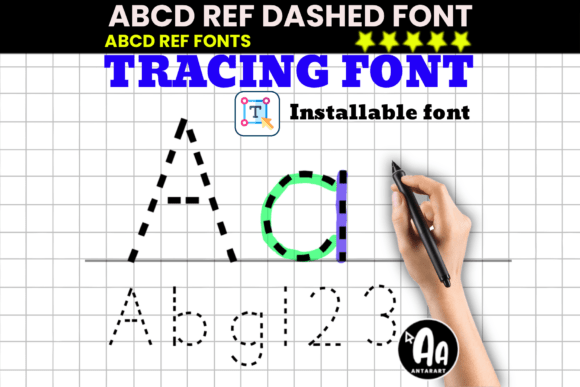
Early childhood educators and curriculum designers understand that handwriting instruction relies heavily on visual consistency. When teaching letter formation to children aged four through eight, the specific style of tracing font used can significantly impact student success and cognitive load. The Abcd Ref Dashed Dotted Tracing font addresses this need by providing a standardized, classic dot-line alphabet system familiar to most early learning environments. Unlike decorative or novelty display fonts, this typeface is engineered specifically for pedagogical utility, offering clean lines and predictable stroke paths that support motor skill development in PreK, Kindergarten, and early elementary grades.
For teachers, homeschoolers, and content creators, the value of this resource lies in its versatility and technical compatibility. It bridges the gap between professional publishing standards and accessible classroom creation tools. Whether you are designing custom worksheets in Microsoft Word, creating bulletin board letters in Canva Pro, or developing comprehensive handwriting books in Adobe InDesign, this font maintains its integrity across platforms. Understanding its practical applications, limitations, and best-use scenarios helps professionals determine if it aligns with their specific instructional goals or design workflows.
Core Characteristics and Pedagogical Design
The primary strength of the Abcd Ref Dashed Dotted Tracing font is its adherence to traditional manuscript formation guidelines. The design features distinct starting dots and directional dashed lines that guide the pencil stroke without overwhelming the student. This "classic" aesthetic is intentional; it mirrors the handwriting programs already present in many school districts, reducing confusion for students who may be transitioning between home and school practice.
- Visual Clarity: The glyphs are unadorned and geometrically simple, ensuring that young learners focus on stroke mechanics rather than interpreting stylized letter shapes.
- Comprehensive Character Set: Beyond uppercase and lowercase letters, the font includes numerals and essential punctuation marks, allowing for complete sentence construction and math integration within tracing activities.
- Editable Name Templates: A significant time-saver for educators is the inclusion of editable name templates. Personalization increases student engagement, and having pre-formatted templates streamlines the creation of individualized homework packets or center activities.
- Stroke Consistency: Every letter maintains uniform line weight and dash spacing, which is critical for developing muscle memory and spatial awareness in emerging writers.
From a design perspective, the minimalism of this font ensures high legibility even when printed at smaller sizes or on lower-quality office printers. This reliability is essential for teachers producing high-volume daily practice sheets where print clarity cannot be compromised.
Technical Compatibility and Workflow Integration
A common friction point for educators creating their own resources is software incompatibility. Fonts that work beautifully in one program may render incorrectly or fail to install in another. Abcd Ref Dashed Dotted Tracing is formatted as a standard installable font file, making it universally compatible with virtually any modern design or word processing software.
Professionals using Microsoft Word or PowerPoint will find the font integrates seamlessly into existing document templates, allowing for quick adjustments to lesson plans without needing advanced graphic design skills. For those utilizing Canva Pro, the ability to upload and use custom fonts means classroom decor and digital slides can match physical worksheets perfectly. Creative professionals working in Adobe Illustrator, Inkscape, or Gimp can leverage the vector-based nature of the font to scale letters for large-format bulletin boards without pixelation.
This cross-platform flexibility supports a unified branding approach for homeschool curricula or classroom environments. When the alphabet chart on the wall matches the tracing sheet on the desk and the digital presentation on the screen, students receive reinforced visual cues that accelerate learning. The ease of installation also means substitute teachers or parent volunteers can quickly access and utilize these resources without extensive technical troubleshooting.
Practical Applications Across Educational Settings
The utility of this font extends beyond simple tracing worksheets. Its clean aesthetic makes it suitable for a variety of educational products and environmental designs.
- Independent Practice Centers: Create laminated tracing cards for literacy centers. The bold starting dots serve as tactile anchors for dry-erase markers, supporting repetitive practice without paper waste.
- Back-to-School Review Packets: Develop customized summer bridge or back-to-school review materials. The inclusion of numbers allows for integrated math and literacy warm-ups.
- Classroom Environment: Use the font to create consistent labeling systems, calendar cards, and word walls. Environmental print that matches instructional fonts reinforces letter recognition passively throughout the day.
- Handwriting Books: Self-publishers and curriculum developers can produce professional-grade workbook interiors. The font’s licensing and quality typically meet the standards required for commercial educational printing.
- Special Education Resources: The high-contrast, distraction-free design is particularly beneficial for students with visual processing difficulties or attention challenges, providing a clear path for motor planning.
Evaluating Effectiveness and User Considerations
While Abcd Ref Dashed Dotted Tracing is a robust tool, professionals should evaluate it against their specific methodology. Handwriting instruction is not monolithic; different regions and programs emphasize different stroke sequences and letter formations. This font follows a traditional ball-and-stick manuscript style. Educators using specialized programs like Handwriting Without Tears or specific cursive-transition methods should verify that the glyph shapes align with their taught curriculum before mass-producing materials.
Additionally, while the font provides the visual model for letter formation, it does not inherently teach the kinesthetic movement. Teachers must still provide explicit verbal and physical modeling. The font is a scaffold, not a replacement for direct instruction. However, as a scaffolding tool, it performs exceptionally well. The dashed lines offer just enough guidance to prevent frustration while requiring enough active recall to build neural pathways.
For content creators selling educational resources on platforms like Teachers Pay Teachers, this font offers a professional polish that distinguishes premium products from amateur freebies. The consistency of the letterforms suggests a curated, intentional curriculum rather than a collection of mismatched clip art. This perceived quality can directly influence buyer trust and conversion rates.
Long-Term Value and Resource Management
Investing in a high-quality tracing font yields compounding returns over an academic year or career. Unlike subscription-based worksheet generators, owning the font file grants perpetual access. Teachers can update old materials, adapt resources for new grade levels, and respond to immediate student needs without recurring costs.
The editable name template feature alone justifies the investment for many K-2 teachers. Creating personalized name tracing strips is a weekly task in early childhood classrooms; automating this process saves hours of preparation time per month. Furthermore, the ability to generate custom vocabulary lists for science or social studies units means the font remains relevant beyond basic alphabet instruction, growing with the students’ expanding curriculum.
Ultimately, Abcd Ref Dashed Dotted Tracing serves as a foundational asset for anyone serious about early literacy resource creation. It balances pedagogical soundness with technical accessibility, removing barriers between instructional intent and tangible student materials. For the target demographic of educators and creators aged 20–50, it represents a practical, reliable solution that respects both the science of reading and the realities of classroom management. By prioritizing clarity, compatibility, and comprehensive character support, it enables professionals to produce effective, engaging handwriting resources that stand up to the demands of real-world education.