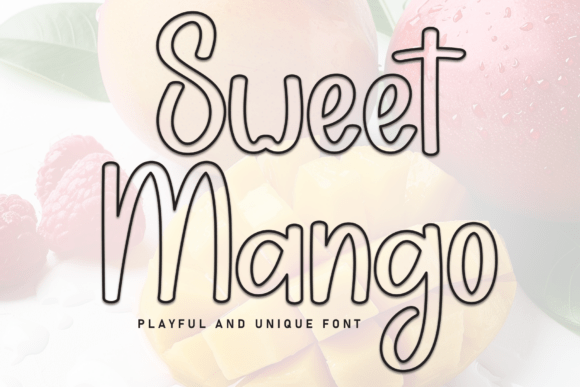
Evaluating Sweet Mango for Display Typography
Selecting the appropriate typeface is a foundational decision in visual communication, influencing how an audience perceives tone, credibility, and accessibility. Sweet Mango is a casual and neat display font designed to bring warmth and clarity to creative projects. Unlike highly stylized script fonts or rigid geometric sans-serifs, this typeface occupies a middle ground that prioritizes approachability without sacrificing structural integrity. For designers and brand managers evaluating typography options, understanding the specific utility of Sweet Mango helps determine if it aligns with project goals regarding readability, emotional resonance, and versatile application.
Defining the Visual Character of Sweet Mango
Sweet Mango is categorized as a display font, meaning it is primarily engineered for use at larger sizes in headlines, logos, and short-form messaging rather than extended body text. Its defining characteristic is a balance between casual aesthetics and neat construction. The letterforms avoid excessive ornamentation or erratic baselines, which are common pitfalls in the "casual" genre. Instead, the design offers a clean structure that maintains legibility even when scaled down for secondary headers or social media graphics.
The visual weight of Sweet Mango is generally consistent, providing a stable texture across a line of text. This stability contributes to its described charm; it feels handcrafted yet disciplined. For evaluators, this distinction is crucial. Many casual fonts sacrifice spacing and alignment for stylistic flair, resulting in text that looks messy in professional contexts. Sweet Mango’s adherence to balanced proportions makes it suitable for environments where a friendly tone must coexist with organizational clarity.
Primary Use Cases and Strategic Fit
When considering Sweet Mango for a design system or standalone project, it is most effective in scenarios requiring immediate emotional connection paired with rapid information processing. The font’s strengths manifest clearly in specific applications:
- Brand Identity and Logotypes: For brands in the food and beverage, lifestyle, children’s education, or artisanal sectors, Sweet Mango communicates authenticity. It avoids the corporate sterility of standard sans-serifs while remaining more legible than traditional hand-lettering.
- Editorial Headlines: In magazines, blogs, or newsletters focused on wellness, cooking, or personal development, this typeface serves as an inviting entry point. It signals to the reader that the content is accessible and conversational.
- Packaging Design: Product labels often require high impact within limited space. The neat structure of Sweet Mango allows for tight tracking without character collision, ensuring product names remain distinct on crowded shelves.
- Digital Interfaces: For websites or apps targeting a non-technical audience, using this font in hero sections or call-to-action buttons can reduce cognitive friction by establishing a welcoming atmosphere before the user engages with functional elements.
Benefits and Practical Advantages
The primary benefit of integrating Sweet Mango into a design workflow is its versatility within the warm-casual niche. Evaluators should note that "warmth" in typography often correlates with reduced formality, but Sweet Mango retains enough neutrality to pair well with various supporting typefaces. It does not dominate a layout aggressively, allowing it to function harmoniously alongside neutral body copy such as Inter, Roboto, or Open Sans.
Furthermore, the font’s readability sets it apart from competitors in the casual display category. Readability in display type is often subjective, but objectively, Sweet Mango features open apertures and distinct character differentiation. This reduces misreading risks in quick-glance environments like signage or mobile screens. For projects where inclusivity and accessibility are priorities, this clarity ensures that the aesthetic choice does not create barriers for users with visual processing differences.
Tradeoffs and Limitations
No typeface is universally applicable, and objective evaluation requires acknowledging where Sweet Mango may fall short. As a display font, it lacks the optical sizing necessary for long-form reading. Using it for paragraphs exceeding two or three lines will likely cause eye strain due to its unique character shapes and spacing metrics. Designers must plan for a separate, highly legible body font to handle informational density.
Additionally, the specific personality of Sweet Mango may be too informal for certain industries. Sectors requiring high degrees of authority, tradition, or technical precision—such as legal services, financial institutions, or medical research—may find the font’s approachable style undermines their message of expertise. In these contexts, the warmth intended by the designer could be misinterpreted as a lack of seriousness. Evaluators must weigh the target audience's expectations against the font’s inherent casualness.
Technical considerations also apply. While the font is neat, casual display fonts sometimes have limited language support or fewer OpenType features compared to comprehensive super-families. If a project requires extensive multilingual support, ligatures, or alternate stylistic sets for complex layouts, it is necessary to verify that Sweet Mango’s character set meets those technical specifications before licensing.
Comparative Evaluation and Alternatives
When comparing Sweet Mango to alternatives, the decision often hinges on the desired level of structure versus expression. If a project requires more organic, handwritten energy, a true script or brush font might be preferable, though at the cost of legibility. Conversely, if the goal is warmth with maximum corporate safety, a rounded sans-serif like Quicksand or Varela Round might offer similar vibes with greater neutrality and broader language support.
Sweet Mango distinguishes itself through its specific blend of casual intent and neat execution. It is less rigid than a rounded sans-serif but more structured than a marker font. This positioning makes it an ideal candidate for projects that have outgrown playful novelty fonts but are not ready to adopt austere modernism. When testing alternatives, evaluators should mock up actual headlines rather than relying on specimen sheets, as the interplay of letterforms in Sweet Mango creates a unique rhythm that only becomes apparent in context.
Making the Final Selection Decision
Determining whether Sweet Mango aligns with your goals requires a practical assessment of the project’s hierarchy and tone. Create a test matrix involving three key questions: Does the audience value approachability over authority? Will the font be used exclusively at display sizes? Does the visual texture complement existing brand assets?
If the answer to these questions is affirmative, Sweet Mango represents a strong strategic choice. It offers a reliable solution for bringing genuine, inviting character to visual communications without introducing the chaos often associated with casual typography. However, if the project demands high-density readability, multi-tiered typographic complexity, or institutional gravitas, resources may be better allocated toward a more utilitarian type family. Ultimately, Sweet Mango serves as a specialized tool for fostering connection, best utilized when clarity and warmth are the primary metrics of success.