Evaluating Poppy Flower Monogram for Elegant Event Stationery
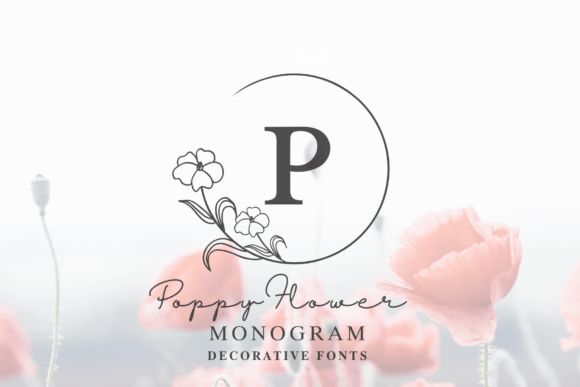
Poppy Flower Monogram is a specialized display typeface designed specifically for high-impact, low-volume text applications such as wedding invitations, formal announcements, and luxury branding. Unlike standard body fonts or general-purpose scripts, this typeface integrates decorative letterforms directly within an intricate floral frame. The design creates a self-contained visual unit where the typography and illustration function as a single element. For designers and individuals planning special occasions, understanding the specific utility of Poppy Flower Monogram requires looking beyond its aesthetic appeal to evaluate its functional role in a broader typographic hierarchy.
The primary distinction of Poppy Flower Monogram lies in its composite nature. Most floral fonts offer separate dingbats or ornaments that must be manually positioned around text. In contrast, this font embeds the botanical framework into the character map itself. When a user types a letter, they are not merely accessing a glyph but retrieving a pre-designed composition. This integration solves common alignment issues found in DIY invitation design, ensuring that the monogram remains perfectly centered and proportioned regardless of the software used. However, this convenience comes with specific constraints regarding customization and layout flexibility that must be weighed against other available options.
Distinguishing Features Against Standard Floral Scripts
When comparing Poppy Flower Monogram to traditional floral script fonts, the difference in application becomes immediately apparent. Standard script fonts with floral swashes are typically linear; they flow horizontally and are intended for names, titles, or short phrases. Poppy Flower Monogram is radial and static. It is engineered to serve as a focal point or a seal rather than a line of readable text.
- Visual Weight: Traditional scripts distribute visual weight across a line. Poppy Flower Monogram concentrates weight in a single square or circular footprint, making it significantly heavier on the page.
- Readability vs. Recognition: While script fonts prioritize legibility for reading, this monogram prioritizes recognition and ornamentation. The letters inside the flower frame are often stylized to fit the organic curves of the petals, which can reduce instant readability at smaller sizes.
- Spacing Requirements: Linear scripts require careful kerning between characters. This monogram requires substantial negative space around the entire unit to prevent it from feeling crowded or competing with adjacent elements.
This distinction is critical for decision-making. If the goal is to write out "The Wedding of Sarah and James" in a flowing, botanical style, a standard floral script is likely the superior choice. If the goal is to create a standalone emblem for envelope seals, menu headers, or the primary cover of an invitation suite, Poppy Flower Monogram fulfills a niche that linear scripts cannot address effectively.
Tradeoffs Between Integrated Frames and Modular Design
A key evaluation factor for resourceful designers is whether to use an integrated font like Poppy Flower Monogram or to construct a similar look using modular components (separate vector flowers and independent lettering). Both approaches have valid use cases, and the right choice depends on the project's timeline, budget, and need for uniqueness.
The Case for Integration
Poppy Flower Monogram offers significant efficiency advantages. Because the frame and letter are unified, there is no need for manual masking, layering, or path manipulation. This makes it an ideal solution for non-designers using template-based platforms or for professionals working under tight deadlines. The consistency of the stroke width between the flower and the letter ensures a cohesive look that can be difficult to achieve when mixing assets from different sources. Furthermore, as a font file, it scales infinitely without pixelation, maintaining crisp edges for print production at any size.
The Case for Modularity
Conversely, constructing a monogram from separate elements offers greater creative control. With a fixed font, users are limited to the specific poppy variety and letter styles included in the character set. If a wedding theme calls for peonies, eucalyptus, or a specific geometric border, Poppy Flower Monogram will not suffice. Modular design also allows for color separation; users can easily make the flower green and the letter gold. In many integrated monogram fonts, changing the color of the letter independently from the frame requires advanced vector editing skills or is impossible within basic word processing software.
For those evaluating their options, the decision matrix is straightforward: choose Poppy Flower Monogram for speed, consistency, and ease of use; choose modular assembly for thematic specificity, color versatility, and bespoke artistry.
Optimal Use Cases and Practical Applications
Understanding where Poppy Flower Monogram performs best helps prevent misuse that could detract from an event's sophistication. Due to its ornate density, this typeface thrives in environments where it can act as an anchor.
Invitation Suite Covers: The font is most effective as the primary visual on the front of an invitation folder or pocket. Here, the intricate details can be appreciated at a larger scale, setting the tone before the guest reads the logistical details inside.
Wax Seals and Stickers: The radial symmetry of the poppy frame translates exceptionally well to circular formats. It provides a professional, custom-stamped appearance for envelope closures or favor tags without the cost of custom die-cutting.
Social Media Announcements: For digital save-the-dates or Instagram stories, the high contrast and distinct silhouette of the monogram remain legible even on small mobile screens, unlike finer, more delicate vintage scripts that may blur or disappear.
However, there are situations where this font should be avoided. It is generally unsuitable for body text, RSVP cards with multiple lines of information, or signage requiring long-distance readability. The decorative complexity that makes it charming at 72pt renders it illegible at 12pt. Additionally, because the design is inherently feminine and romantic, it may clash with minimalist, industrial, or ultra-modern event aesthetics. Evaluators should always test the font in the actual context of their layout rather than judging it solely from a specimen sheet.
Technical Considerations for Print and Digital
When incorporating Poppy Flower Monogram into professional workflows, technical specifications matter as much as aesthetic ones. Users comparing this font against free alternatives or generic clip art should consider the production implications.
Vector Integrity: Ensure the version of Poppy Flower Monogram being evaluated is a true vector outline font rather than a rasterized image embedded in a font container. True vectors allow for sharp printing on textured papers like linen or cotton, where ink bleed can soften fine details. Rasterized versions may appear jagged or blurry when scaled up for large-format welcome signs.
Licensing and Usage: Unlike system fonts, decorative monogram fonts often carry specific licensing restrictions. Users must verify whether the license covers personal use only or extends to commercial client work. For those designing for others, confirming that the End User License Agreement (EULA) permits usage in sold stationery suites is a mandatory step in the evaluation process.
Software Compatibility: While OpenType features are standard in professional design software, some decorative monograms rely on Private Use Area (PUA) encoding to access alternate frames or ligatures. Users working in Canva, Microsoft Word, or Cricut Design Space should verify that all desired glyphs are accessible without specialized font management tools. A font that looks perfect in Adobe Illustrator but lacks accessible alternates in consumer-grade software may not be the practical choice for DIY projects.
Making the Final Selection
Poppy Flower Monogram represents a specific intersection of typography and illustration that serves a distinct purpose in event design. It excels when the objective is to convey elegance, tradition, and botanical charm through a singular, polished symbol. Its strengths lie in its cohesiveness, ease of implementation, and immediate visual impact.
However, it is not a universal solution. Those seeking extensive customization, multi-color flexibility, or thematic variety outside the poppy motif may find better value in modular vector packs or alternative botanical typefaces. Similarly, projects requiring high-density text or modern minimalism should look elsewhere.
Ultimately, the decision to utilize Poppy Flower Monogram should be driven by the specific needs of the project hierarchy. When used correctly—as a headline element, a seal, or a branding anchor—it adds a layer of sophistication that elevates the entire stationery suite. When evaluated against project requirements, technical capabilities, and aesthetic goals, it stands as a valuable tool in the curated arsenal of celebration typography, provided its limitations are respected and its strengths are leveraged with intention.