Tying Design Together: Practical Applications of the Rope Knots Typeface
The Intersection of Maritime Heritage and Digital Typography
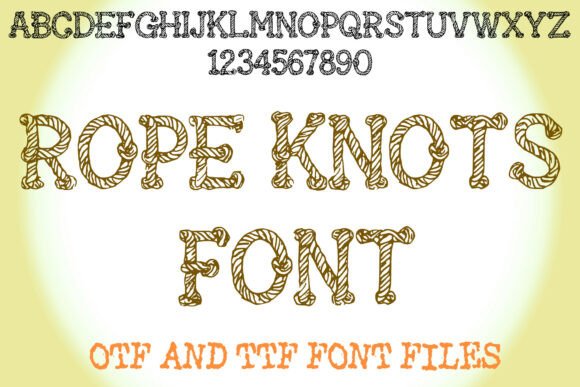
In the vast landscape of graphic design, typography serves as the primary vehicle for tone and atmosphere. While clean sans-serifs dominate corporate communication and elegant serifs define editorial luxury, niche display typefaces occupy a unique space where visual texture communicates meaning before a single word is read. The Rope Knots font exemplifies this category, functioning not merely as a set of letterforms but as an immediate cultural signifier. Designed to mimic the tactile reality of twisted hemp and sailor’s knots, this typeface bridges the gap between historical maritime tradition and modern digital aesthetics.
Understanding the utility of such a specialized tool requires looking beyond novelty. For designers, educators, and business owners, selecting a nautical-themed display typeface is a strategic decision regarding audience engagement. The intricate loops and fibrous textures inherent in the Rope Knots design trigger specific psychological associations: durability, adventure, tradition, and playfulness. These associations are critical when establishing brand identity or thematic consistency for projects ranging from coastal tourism marketing to elementary school educational materials. The success of using this typeface lies in understanding its weight, legibility constraints, and optimal environmental pairings.
Navigating Brand Identity for Coastal Businesses
For businesses operating within the maritime sector, visual authenticity is a currency. Seafood restaurants, charter boat services, surf shops, and coastal bed-and-breakfasts face the challenge of distinguishing themselves in a saturated market. Standard nautical clichés often fail to resonate because they lack specificity. Integrating Rope Knots into branding assets offers a layer of textural depth that standard vector icons cannot achieve.
When applied to signage, menu headers, or packaging, the font acts as a tactile anchor. Consider a craft brewery located in a historic port city. Using a generic bold font for their label might communicate strength, but it fails to communicate place. By utilizing Rope Knots for the product name or limited-edition series titles, the designer invokes the region's industrial history. However, professional application requires restraint. Because the letterforms are visually dense, they function best as headlines or logos rather than body copy. Pairing this display face with a clean, high-legibility sans-serif ensures that while the aesthetic remains thematic, the essential information—such as ingredients, prices, or safety instructions—remains accessible to all consumers.
Educational Utility and Tactile Learning Environments
Beyond commercial branding, the Rope Knots typeface finds significant utility in educational and developmental settings. Visual learning relies heavily on pattern recognition and thematic immersion. For educators teaching maritime history, geography, or literature involving oceanic narratives, the environment plays a crucial role in student retention. Typography is a subtle but constant component of that environment.
- Thematic Consistency: Worksheets, presentation slides, and classroom posters featuring rope-style lettering reinforce the subject matter subconsciously, creating a cohesive learning narrative.
- Sensory Engagement: For younger students, the textured appearance of the font mimics physical objects they may encounter in hands-on activities, bridging the gap between abstract text and concrete reality.
- Literature Enhancement: When creating custom reading materials for classics like Treasure Island or Moby Dick, using thematic typography helps distinguish chapter titles or pull quotes, breaking up dense text blocks and maintaining reader interest.
This application extends to museum curation and interpretive center design. Exhibits focusing on naval history or marine biology benefit from wayfinding and informational placards that reflect the era or ecosystem being discussed. Here, Rope Knots serves as a functional design element that guides visitors through a narrative journey, proving that decorative fonts can have serious pedagogical value when deployed with intention.
Event Design and Experiential Marketing
The experiential economy demands immersive environments, particularly in event planning. Pirate parties, regattas, beach weddings, and maritime festivals require visual systems that transport attendees immediately upon receiving an invitation. In this context, typography sets the expectation for the experience. A formal serif suggests a black-tie gala, whereas Rope Knots signals a relaxed, interactive, and historically flavored gathering.
For event organizers, the versatility of this typeface allows for scalability across different media. It translates effectively from small-scale digital invitations to large-format vinyl banners and stage backdrops. The key advantage in event design is its ability to convey "fun" without sacrificing structure. Unlike hand-drawn lettering which can sometimes appear messy or amateurish, a digitized font like Rope Knots provides uniform spacing and alignment, ensuring that even playful pirate party invites maintain a level of professional polish necessary for ticketed events. Furthermore, for DIY enthusiasts and parents crafting homemade decorations, the font provides an accessible shortcut to achieving a high-end, custom look without requiring advanced illustration skills.
Technical Considerations for Optimal Legibility
While the aesthetic appeal of Rope Knots is undeniable, successful implementation depends on technical proficiency. Display typefaces with high levels of ornamentation present unique challenges in reproduction and readability. Designers must navigate these constraints to ensure the final output is both beautiful and functional.
- Scale and Resolution: The intricate details of twisted rope textures can be lost at small sizes or low resolutions. This font performs optimally at larger point sizes where the individual strands remain distinct. For web use, SVG formats are preferable to raster images to prevent pixelation on high-density screens.
- Contrast Management: Due to the complex internal negative space within the letters, contrast against the background is paramount. Dark rope textures on dark backgrounds will result in illegibility. High-contrast pairings, such as navy blue lettering on cream paper or white text on weathered wood textures, preserve the definition of the knots.
- Kerning and Spacing: Ornamental fonts often have irregular bounding boxes. Manual kerning adjustments are frequently necessary to prevent overlapping ascenders and descenders from creating visual clutter. Tighter tracking may work for all-caps headlines, while looser tracking might be needed for mixed-case usage to allow the knot details to breathe.
- Hierarchy Establishment: Never use Rope Knots for paragraphs or extended reading. Its cognitive load is too high for sustained reading. Restrict its use to H1 headers, logos, drop caps, or short callouts. Let complementary typefaces handle the heavy lifting of information delivery.
Cultural Resonance and Audience Perception
Typography carries cultural baggage, and nautical themes are no exception. When utilizing Rope Knots, creators must be mindful of the specific connotations they wish to evoke. The font straddles the line between historical accuracy and caricature. In professional contexts, such as a heritage museum or a high-end yacht club, the goal is often to evoke craftsmanship and tradition. In these cases, pairing the font with muted, authentic color palettes (ochres, navys, unbleached whites) grounds the design in reality.
Conversely, in children’s entertainment or casual retail, the same font can signal whimsy and fantasy. Bright colors and rounded supporting graphics shift the perception toward play. Understanding this spectrum allows designers to modulate the tone of their project precisely. It is also worth noting the global universality of maritime symbolism; knots and ropes are recognized across cultures as symbols of connection, security, and seafaring, making this typeface effective for international audiences where language barriers might exist but visual archetypes remain constant.
Materiality in Digital Spaces
A growing trend in digital design is skeuomorphism’s evolution into "new tactility," where digital interfaces seek to replicate the feeling of physical materials. Rope Knots fits perfectly into this movement. As users become fatigued by flat, sterile interface design, there is a renewed appreciation for texture and warmth. Incorporating this typeface into website hero sections, app splash screens, or social media templates adds a layer of organic humanity to the digital experience.
This materiality is particularly relevant for e-commerce sites selling handmade goods, outdoor gear, or artisanal products. The font reinforces the value proposition of craftsmanship. When a user sees a headline rendered in what looks like hand-tied rope, they subconsciously attribute qualities of labor, care, and durability to the products below it. This psychological priming is a powerful conversion tool. However, performance must be balanced with aesthetics. Web fonts with complex outlines can impact load times. Implementing font-display strategies and limiting the character set to only necessary glyphs ensures that the site remains fast and responsive, preserving the user experience alongside the visual theme.
Strategic Pairing and Compositional Balance
No typeface exists in isolation. The effectiveness of Rope Knots is largely determined by what surrounds it. Successful composition involves creating a dialogue between the ornamental and the structural. A common mistake is pairing two highly decorative fonts, which results in visual noise. Instead, designers should seek contrast.
A geometric sans-serif provides a modern counterpoint that prevents the nautical theme from feeling dated or costume-like. Alternatively, a traditional humanist serif can enhance the historical aspect, suitable for storytelling or heritage brands. For craft projects and physical decor, the pairing extends to substrates. Printing Rope Knots on textured cardstock, kraft paper, or canvas enhances the illusion of real rope, whereas printing on glossy, synthetic materials can create a dissonance between the visual texture and the physical surface. Recognizing these relationships between type, support, and context transforms the font from a mere decorative asset into a comprehensive design solution capable of communicating complex thematic messages with clarity and impact.