Evaluating Medical Equipment Nurse for Healthcare Design Projects
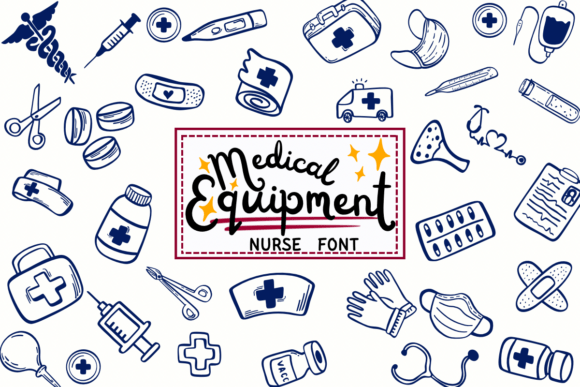
Selecting typography for healthcare communications requires balancing clinical accuracy with emotional accessibility. Medical Equipment Nurse is a specialized font package that combines a playful dingbat set with a cheerful handwritten display typeface. Unlike standard medical fonts that prioritize sterile legibility, this collection introduces hand-drawn elements such as syringes, pills, and stethoscopes to create a warmer visual tone. For designers, educators, and healthcare administrators evaluating assets for pediatric care, health awareness campaigns, or educational printables, understanding the specific utility and limitations of this font is essential for effective decision-making.
Defining the Asset: More Than Just Typography
Medical Equipment Nurse functions as both a text tool and an illustration library. The primary component is a display font characterized by rounded strokes and irregular baselines, mimicking natural handwriting rather than digital precision. This stylistic choice signals approachability and reduces the intimidation factor often associated with medical environments. The secondary component is the dingbat layer, which maps vector-style medical icons to keyboard characters. This integration allows users to insert relevant graphics without leaving their word processor or design software, streamlining workflows for non-designers creating internal materials or patient handouts.
When evaluating this asset, it is important to categorize it correctly. It is not a body copy font intended for dense paragraphs or legal disclaimers. Instead, it serves as a headline, accent, or decorative element designed to support specific messaging goals related to friendliness and clarity in niche healthcare contexts.
Strategic Benefits for Patient-Centric Design
The primary value proposition of Medical Equipment Nurse lies in its ability to humanize clinical information. In pediatric branding and child life specialist resources, traditional serif or sans-serif fonts can appear overly serious or alarming. The doodle-style aesthetic of this font aligns with developmental needs, helping to lower anxiety in young patients and making educational materials about procedures feel less threatening.
- Visual Shorthand: The integrated icons provide immediate context. A stethoscope icon next to a header instantly communicates "check-up" or "doctor visit" without requiring additional cognitive processing, which is beneficial for low-literacy audiences or multilingual environments.
- Tone Modulation: For health awareness posters regarding sensitive topics like vaccination or hygiene, the playful nature of the font can soften the delivery of mandatory or corrective information, potentially increasing receptiveness.
- Workflow Efficiency: For nursing staff or educators creating ad-hoc resources, having icons embedded within the font file eliminates the need to source, license, and format separate clip art, ensuring visual consistency across documents.
Critical Tradeoffs and Limitations
While Medical Equipment Nurse excels in specific niches, objective evaluation requires acknowledging where it falls short. The very characteristics that make it friendly also impose functional constraints that may disqualify it for certain professional applications.
Legibility and Accessibility Concerns
Handwritten display fonts inherently sacrifice readability for style. Medical Equipment Nurse should never be used for critical patient instructions, dosage information, or emergency signage. The irregular letterforms can be difficult for individuals with dyslexia, visual impairments, or cognitive processing disorders to decode quickly. When accessibility compliance (such as WCAG standards) is a priority, this font must be restricted to purely decorative roles, paired with a highly legible sans-serif for all substantive content.
Professional Perception Risks
Context dictates appropriateness. While ideal for pediatrics or community wellness fairs, this font may undermine credibility in acute care, oncology, geriatrics, or administrative policy documents. In these settings, patients and stakeholders expect professionalism and gravity; a playful doodle font could be perceived as trivializing serious health matters. Evaluators must assess whether the target demographic associates "hand-drawn" with "caring" or with "unprofessional."
Technical Versatility
Dingbat fonts are platform-dependent and can cause compatibility issues when sharing editable files between different operating systems or software versions. If a document created with Medical Equipment Nurse is opened on a device lacking the font, the icons will revert to random characters or empty boxes. For widely distributed digital PDFs, embedding is necessary; for collaborative templates, converting dingbats to outlined shapes or images is often safer than relying on live font rendering.
Situational Fit: When to Choose This Font
Decision-makers should consider Medical Equipment Nurse a strong fit when the project meets the following criteria:
- The Audience is Pediatric or Family-Oriented: The design targets children, parents, or caregivers in non-critical settings.
- The Goal is Engagement Over Precision: The material is promotional, educational, or celebratory (e.g., Nurse’s Week cards, clinic open houses) rather than regulatory or instructional.
- The Format is Large-Scale or Low-Density: Usage is limited to headlines, bullet points, or borders where ample white space supports the ornate letterforms.
- The Brand Voice is Warm and Personal: The organization explicitly cultivates a boutique, holistic, or community-based identity rather than a high-tech or institutional one.
When to Consider Alternatives
Evaluators should look elsewhere if the project involves high-stakes communication, diverse age groups including seniors, or formal institutional branding. In these cases, consider these alternatives:
- Rounded Sans-Serif Fonts: Typefaces like Nunito, Quicksand, or Varela Round offer softness and approachability similar to Medical Equipment Nurse but maintain the geometric consistency required for body text and better accessibility scores.
- Dedicated Icon Libraries: For projects needing medical imagery alongside professional typography, using a separate SVG icon set (such as FontAwesome Medical or custom illustrations) provides greater scalability and styling control than dingbat characters.
- Humanist Serifs: For adult-focused healthcare that still wants to avoid sterility, humanist serifs convey warmth and tradition without the informality of handwritten display faces.
Practical Decision-Making Framework
Before licensing or deploying Medical Equipment Nurse, conduct a brief contextual audit. Test the font at the actual intended size and viewing distance; what looks charming at 72pt on a screen may become illegible at 18pt in print. Verify that the included icons accurately represent current medical equipment, as stylized dingbats sometimes depict outdated tools that could confuse modern patients. Finally, ensure there is a clear hierarchy plan: define exactly which font will carry the informational load so that Medical Equipment Nurse remains a supportive accent rather than a barrier to comprehension.
Ultimately, Medical Equipment Nurse is a specialized tool for softening the clinical edge of healthcare design. Its effectiveness depends entirely on alignment between its playful aesthetic and the specific emotional needs of the audience. By weighing its unique charm against legitimate accessibility and professionalism concerns, designers and healthcare communicators can determine whether it enhances their message or detracts from their mission.