Evaluating Drip Town: A Practical Guide to Retro Bubble Typography
In the current landscape of graphic design, the resurgence of 1970s aesthetics has moved beyond fleeting trends to become a stable stylistic pillar. For designers and marketers navigating this revival, selecting the right typeface is often the difference between an authentic homage and a generic imitation. Drip Town enters this space as a specialized display font that merges bubble-style lettering with fluid, organic movement. Unlike standard rounded sans-serifs, this typeface offers a distinct personality defined by wavy baselines and playful drip elements. Understanding its specific utility requires looking past its novelty to evaluate how it functions within professional branding, apparel design, and digital media workflows.
Defining the Visual Characteristics
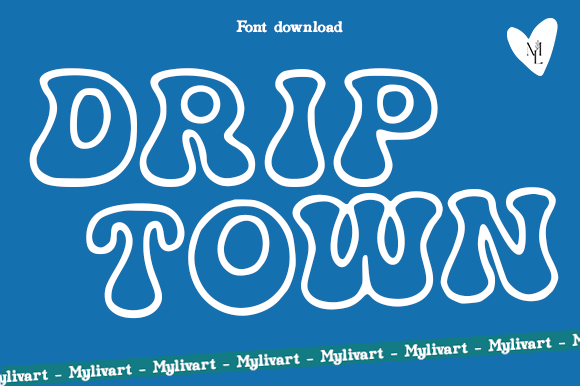
Drip Town is categorized as a retro display typeface, but its construction reveals a deliberate balance between nostalgia and modern legibility. The primary identifier is the "bubble" form factor—letters are inflated and rounded, evoking the soft signage and album art of the mid-70s. However, what distinguishes it from similar vintage fonts is the integration of liquid dynamics. The drips are not merely appended decorations; they influence the rhythm of the word shapes, creating a sense of downward motion and fluidity.
The stroke weight is consistently bold, which serves a functional purpose beyond aesthetics. In digital environments where compression can degrade fine details, thick outlines maintain integrity across various screen sizes. The wavy lines introduce a horizontal cadence that guides the eye, preventing the static appearance common in rigid geometric fonts. This combination results in a typeface that feels hand-drawn yet retains enough structural consistency for commercial application. It avoids the chaotic irregularity of grunge fonts while steering clear of the sterile perfection of vector-generated retro revivals.
Practical Applications and Use Cases
While versatile, Drip Town is not a universal solution. Its value lies in specific contexts where tone and atmosphere take precedence over information density. Professionals should consider deploying this asset in the following scenarios:
- Music and Event Promotion: The font’s inherent groove aligns naturally with genres like funk, soul, indie rock, and psychedelic pop. It communicates genre expectations instantly on posters and streaming thumbnails without requiring additional visual cues.
- Apparel and Merchandise: T-shirt graphics and streetwear often rely on typography as the primary visual element. Drip Town’s bold silhouette holds up well during screen printing and embroidery digitization, where thin lines might fail or require excessive stabilization.
- Lifestyle Branding: Brands targeting Gen Z and Millennials with a focus on wellness, creativity, or sustainability often utilize soft, organic typography to signal approachability. This font provides a vintage warmth that feels established rather than corporate.
- Social Media Headlines: In feed-based platforms, stopping the scroll is paramount. The unique letterforms create high contrast against standard UI fonts, making it effective for Instagram stories, TikTok covers, and YouTube thumbnails.
It is crucial to note that this typeface is strictly for display purposes. Attempting to use Drip Town for body copy, captions, or dense informational text will result in poor readability and user fatigue. Its strengths are exclusively tied to short-form messaging, titles, and logos.
Technical Performance and Workflow Integration
From a production standpoint, the usability of a decorative font depends heavily on technical execution. Drip Town generally performs well in standard design software such as Adobe Illustrator, Photoshop, and Figma. The bold nature of the glyphs allows for easy manipulation; designers can apply strokes, shadows, and warping effects without the letterforms collapsing or becoming unrecognizable.
One practical consideration is kerning and spacing. Due to the irregular drip elements and wavy baseline, automatic tracking settings may produce awkward gaps or overlaps. Manual adjustment is frequently necessary to achieve optical balance. Designers accustomed to working with grid-aligned typefaces may find this requires a shift in workflow, prioritizing visual rhythm over mathematical precision. Additionally, when scaling down for small applications like business cards or mobile icons, the drip details may merge. Testing at actual output size is essential to ensure the character remains distinct.
For web projects, performance matters. Decorative fonts can have larger file sizes due to complex curves. If using Drip Town for web headers, subsetting the font to include only necessary characters can significantly reduce load times. Alternatively, converting headlines to SVG paths ensures consistent rendering across browsers and eliminates FOUT (Flash of Unstyled Text) issues, though this sacrifices accessibility unless proper alt text or aria-labels are implemented.
Audience Fit and Strategic Value
Determining whether Drip Town fits a project requires an honest assessment of brand voice. This typeface carries significant semantic weight; it signals fun, relaxation, creativity, and retro appreciation. It is ill-suited for industries requiring authority, sterility, or urgency, such as finance, healthcare, legal services, or emergency communications. Using it in these contexts creates cognitive dissonance that undermines trust.
However, for the target demographic of creatives, freelancers, and lifestyle entrepreneurs, the font offers substantial strategic value. In a saturated market, differentiation is key. While many brands utilize clean, minimalist sans-serifs to appear modern, adopting a well-executed retro aesthetic can create immediate distinction. Drip Town facilitates this without requiring custom lettering services, offering a cost-effective middle ground between stock typography and bespoke illustration.
Educators and content creators also benefit from its engaging nature. For materials aimed at younger audiences or creative workshops, the playful aesthetic lowers psychological barriers to entry, making learning environments feel less formal and more inviting. The emotional resonance of the typeface does heavy lifting in setting the tone before a single word is read.
Limitations and Considerations
No design asset is without limitations, and acknowledging them prevents misuse. The most significant constraint of Drip Town is its lack of neutrality. It dominates any composition it inhabits. Pairing it with other highly stylized fonts often leads to visual clutter. Best practice dictates combining it with simple, neutral sans-serifs or clean monospaced typefaces that provide breathing room and hierarchy.
Furthermore, the retro trend, while currently strong, is cyclical. Projects intended to be evergreen or timeless should use this font sparingly or in modular ways that allow for future updates. A logo entirely dependent on a specific trendy typeface may require redesigning sooner than one built on structural principles. Drip Town is best utilized as a campaign-specific tool or a secondary brand element rather than the sole foundation of a permanent corporate identity.
Licensing is another practical factor. Professionals must verify the specific license terms for commercial use, especially for merchandise and client work. Ensuring compliance protects both the designer and the end-client from legal complications. Always source from reputable foundries or marketplaces that provide clear documentation regarding desktop, web, and merchandise usage rights.
Final Assessment for Creative Professionals
Drip Town represents a high-quality example of contemporary retro typography. It succeeds because it treats the 70s aesthetic as a design language to be refined rather than merely copied. Its bold personality, fluid curves, and reliable construction make it a valuable asset for specific creative challenges. For marketers needing to evoke nostalgia, designers crafting gig posters, or entrepreneurs building a funky lifestyle brand, it delivers tangible aesthetic value.
Ultimately, the decision to incorporate Drip Town should be driven by project goals rather than novelty. When applied with intention and technical care, it transforms standard layouts into memorable visual experiences. It reminds us that typography is not just about reading words, but about feeling the message behind them. For those whose work benefits from joy, rhythm, and vintage flair, this typeface is a worthy addition to the creative toolkit.