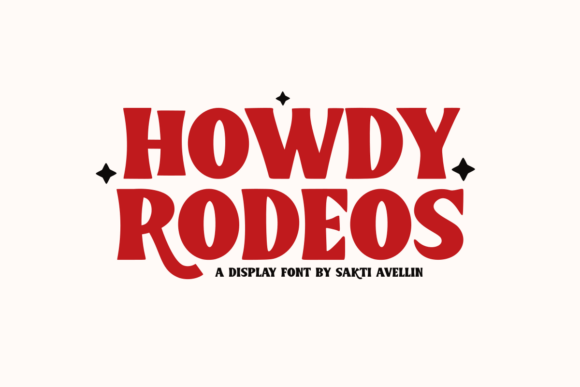
Evaluating Howdy Rodeos for Artisanal Branding and Display Typography
Selecting the appropriate typeface is one of the most critical decisions in visual branding, particularly when targeting niche markets that value craftsmanship and authenticity. Howdy Rodeos has emerged as a notable option within the artisanal display font category, specifically sculpted for designers and brand owners seeking to convey a sense of stylish allure and distinctive character. Unlike standard serif or sans-serif families designed for utility, this typeface operates as a stylistic signature. Understanding its specific attributes, strengths, and limitations is essential for determining whether it aligns with your current project requirements or if an alternative approach would yield better results.
Defining the Aesthetic Profile of Howdy Rodeos
Howdy Rodeos is best classified as an artisanal display font, a category defined by high personality and limited functional range. It is not intended for body copy, navigation menus, or dense informational text. Instead, its design language focuses on evoking a specific emotional response associated with western heritage, rustic elegance, and handcrafted quality. The letterforms are meticulously shaped to suggest manual creation rather than digital precision, featuring irregularities and flourishes that mimic traditional sign painting or leather tooling.
For branding connoisseurs, the value lies in this intentional imperfection. In a digital landscape often dominated by clean, geometric minimalism, Howdy Rodeos offers a tactile counterpoint. It functions effectively as a primary logotype or a headline accent but requires careful pairing with neutral supporting typefaces to maintain readability. When evaluating this font, consider it less as a text tool and more as a graphical element that carries the weight of your brand’s visual identity.
Ideal Applications and Material Compatibility
The versatility of Howdy Rodeos is most apparent when applied to physical merchandise and tactile media. Its design weights and stroke variations have been optimized for reproduction across various substrates, making it a quintessential choice for product-based businesses. However, performance varies significantly depending on the application method and material texture.
- Apparel and Textiles: The font performs exceptionally well on elegant t-shirts and fashionable hats. Its bold, expressive nature allows it to remain legible even when printed on textured fabrics like canvas or denim. For embroidery, however, users must test the finer details, as intricate serifs may require simplification to prevent thread breaks or loss of definition at smaller scales.
- Home Decor and Soft Goods: On plush pillows and woven textiles, Howdy Rodeos adds a layer of sophistication without appearing sterile. The organic curves complement soft materials, whereas rigid geometric fonts can sometimes look out of place on fabric. This makes it suitable for boutique home goods lines aiming for a cozy yet curated aesthetic.
- Hard Goods and Accessories: Creative key chains and personalized mugs benefit from the font’s distinct silhouette. Because these items offer limited surface area, the high recognizability of Howdy Rodeos ensures the message is conveyed instantly. Laser engraving on wood or metal captures the artisanal feel accurately, though users should verify that stroke widths are sufficient for the engraving depth.
- Paper Goods and Stationery: For charming invitation cards and posters, the font serves as an effective hierarchy anchor. It draws the eye to key information such as event names or dates. When used in sophisticated mock-up frames, it demonstrates how the typeface interacts with negative space, helping clients visualize the final branded environment.
Comparative Analysis: Artisanal Display vs. Standard Western Serifs
When researching typography options for western or rustic themes, buyers often encounter a spectrum ranging from historical revivals to modern interpretations. Comparing Howdy Rodeos against these broader categories helps clarify its specific market position.
Traditional western serifs often prioritize historical accuracy, replicating 19th-century woodblock prints with heavy slabs and rigid structures. While authentic, these can sometimes feel costumey or overly aggressive for modern lifestyle brands. Howdy Rodeos differs by integrating contemporary styling cues. It retains the thematic essence of the rodeo but refines the execution to suit current design trends. This balance makes it more adaptable for brands that want to hint at heritage without appearing dated.
Conversely, generic handwritten or brush scripts offer informality but often lack the structural integrity required for professional branding. Many script fonts suffer from poor spacing or inconsistent baselines, making them difficult to use in logos or merchandise layouts. Howdy Rodeos occupies a middle ground; it possesses the fluidity of hand-lettering with the deliberate construction of a display typeface. This distinction is crucial for projects requiring repeated application across different media, where consistency is as important as style.
Evaluating Tradeoffs and Limitations
No typeface is universally applicable, and recognizing the constraints of Howdy Rodeos is vital for avoiding costly redesigns later in the production process. The primary tradeoff is legibility at small sizes. Due to its decorative nature and varying stroke widths, the font loses clarity below certain point thresholds. It is generally unsuitable for legal disclaimers, ingredient lists, contact information blocks, or user interface elements.
Another consideration is tonal specificity. The font carries a strong cultural association. If your brand aims for a neutral, corporate, or futuristic identity, this typeface will create cognitive dissonance. Even within the rustic niche, it leans toward "stylish" and "boutique" rather than "rugged" or "industrial." Designers working on heavy machinery branding or outdoor survival gear might find the elegance of Howdy Rodeos too refined, necessitating a search for heavier, more utilitarian alternatives.
Technical compatibility also warrants attention. Before licensing, verify the inclusion of necessary OpenType features. Access to alternate characters, ligatures, and swashes is often what elevates an artisanal font from a simple alphabet to a comprehensive design system. If your project requires extensive customization or multilingual support, ensure the character set meets those demands, as many display fonts prioritize English alphanumeric sets over extended language coverage.
Decision Framework: When to Choose Howdy Rodeos
Determining whether Howdy Rodeos is the right investment involves assessing three core factors: brand alignment, technical feasibility, and long-term versatility.
Brand Alignment: Choose this font if your objective is to signal artisanal quality, warmth, and curated style. It is particularly effective for businesses selling handmade goods, hospitality venues with a rustic-chic theme, or event planners specializing in barn weddings and heritage festivals. If your audience values aesthetics and storytelling over pure information density, this typeface supports that narrative effectively.
Technical Feasibility: Evaluate your primary output channels. If 80% of your touchpoints are large-format (signage, apparel, packaging headers), Howdy Rodeos is a strong contender. If your primary needs are digital interfaces, long-form editorial content, or data-heavy reports, you should prioritize a robust text family first and treat Howdy Rodeos only as a supplementary asset.
Versatility vs. Novelty: Consider the lifespan of the project. Trend-driven novelty fonts often have a short shelf life. Howdy Rodeos attempts to mitigate this through classic proportions and refined detailing, suggesting better longevity than purely faddish options. However, if you require a timeless, invisible typographic voice that will serve a corporation for decades, a classic serif or humanist sans-serif remains the safer baseline. Use Howdy Rodeos when you need to make a statement now, rather than when you need to blend in forever.
Practical Implementation Strategies
To maximize the effectiveness of Howdy Rodeos, adopt implementation strategies that respect its role as a display element. Pairing is paramount; combine it with a clean, low-contrast sans-serif or a simple monoline serif for body text. This contrast prevents visual competition and ensures the artisanal qualities of the headline font stand out without overwhelming the viewer.
Pay close attention to tracking and leading. Display fonts often require tighter tracking in headlines to create a cohesive word shape, while excessive spacing can break the visual flow of connected letterforms. Conversely, when using the font in all-caps settings (if available and recommended), increased tracking may be necessary to improve legibility. Always test the typeface in the actual context of use—on a shirt mockup, a printed proof, or a screen render—rather than relying solely on the specimen sheet. Real-world rendering reveals nuances in ink spread, pixel alignment, and material interaction that static previews cannot capture.
Ultimately, Howdy Rodeos represents a specific solution to a specific branding challenge. It excels at adding stylish allure and distinctive character to tangible products and experiential graphics. By understanding its comparative advantages against standard western types and acknowledging its functional boundaries, designers and brand managers can leverage this unique signature to create work that feels both authentically crafted and professionally executed. The decision to use it should stem from a clear alignment between the font’s artisanal voice and the strategic goals of the project, ensuring that typography serves as a bridge between creative vision and audience connection.