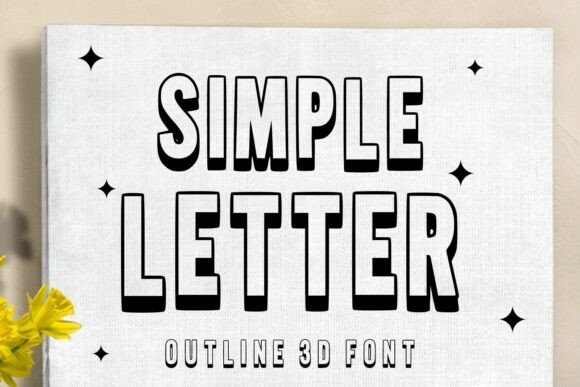
Simple Letter: Elevating Children’s Designs with Elegance and Fun
When designing for children, the line between playful and chaotic is often thinner than we realize. Many creators assume that kid-friendly typography must be messy, overly rounded, or aggressively cartoonish to resonate with a young audience. However, Simple Letter challenges this outdated notion by offering a display font that is simultaneously elegant, bright, and fun. It serves as a sophisticated alternative to standard novelty typefaces, providing a clean aesthetic that appeals to both children and the adults purchasing the products. Understanding how to leverage this specific typeface can transform your projects from amateur crafts into professional, market-ready designs.
Redefining Playful Typography Without Sacrificing Clarity
The primary reason designers and educators gravitate toward Simple Letter is its unique ability to balance whimsy with legibility. A common mistake in children’s branding is selecting fonts that prioritize shape over function. While a dripping slime font or a jagged crayon style might look exciting at first glance, they often fail when scaled down for packaging labels, book spines, or digital thumbnails. Simple Letter retains a bright, cheerful character through its open counters and balanced weight distribution, yet it remains highly readable.
This distinction matters significantly for usability. If you are creating educational materials, flashcards, or early reader books, readability is not optional; it is functional. Using an illegible "fun" font can actually hinder learning and frustrate parents. By choosing Simple Letter, you ensure that the design supports the content rather than competing with it. The elegance inherent in this display font allows it to transition seamlessly from a birthday party invitation to a premium nursery decor print without looking out of place in either context.
Avoiding the Color Clash Trap
One of the most frequent missteps when using bright display fonts is pairing them with equally aggressive color palettes. Because Simple Letter is described as bright and fun, beginners often default to high-saturation neon colors or clashing primary tones. This approach creates visual vibration that tires the eye and cheapens the overall presentation. The font’s elegance is best highlighted when treated with intention regarding color theory.
Instead of matching the font’s energy with loud colors, consider using the pastel palette mentioned in its core description as a grounding element. Soft mints, blush pinks, buttery yellows, and powder blues provide a serene backdrop that allows the typography to pop without screaming. When you need higher contrast, opt for deep, muted tones like navy, forest green, or charcoal rather than pure black. These combinations maintain the child-friendly vibe while elevating the perceived value of the product. Remember that white space is also a color; allowing Simple Letter to breathe against a clean background often yields more professional results than filling every pixel with pattern and hue.
Technical Considerations for Display Fonts
Even the most beautiful typeface can fail if applied incorrectly. A critical oversight involves ignoring optical sizing and spacing adjustments. Simple Letter is a display font, meaning it was engineered for headlines, titles, and short bursts of text. A common error is attempting to use it for body copy or lengthy paragraphs. Doing so destroys the rhythm of the page and makes extended reading difficult. Always reserve Simple Letter for focal points and pair it with a neutral sans-serif or a highly legible serif for supporting text.
Furthermore, do not rely solely on default kerning. Display fonts often require manual tracking adjustments depending on the size and application. At large sizes, such as on a poster or wall art, the default spacing may appear too tight, making the letters feel cramped. Conversely, at smaller sizes, the spacing might look disjointed. Taking thirty seconds to adjust the tracking ensures the word shapes feel cohesive. This small technical correction separates professional designers from hobbyists and ensures your message communicates clarity and quality.
Licensing and Commercial Viability
For entrepreneurs, freelancers, and small business owners, overlooking licensing terms is a costly mistake. You might fall in love with Simple Letter for a new line of children’s apparel or stationery, only to discover later that your license does not cover commercial merchandise. Before integrating this font into any revenue-generating project, verify the specific usage rights. Some licenses cover personal use or limited print runs but require upgraded tiers for digital products, web embedding, or mass manufacturing.
Evaluating the license upfront prevents future legal headaches and unexpected expenses. It also influences your cost-benefit analysis. If Simple Letter perfectly captures your brand identity, investing in the correct commercial license is a business expense that adds tangible value. However, if the licensing restrictions are incompatible with your business model, it is better to identify this limitation before falling in love with the aesthetic. Always check the foundry’s documentation or contact the designer directly if your use case falls into a gray area.
Strategic Pairing and Hierarchy
Simple Letter shines brightest when it has a supporting cast. A frequent design failure is using multiple display fonts in the same composition, which creates visual noise and confusion. Because Simple Letter already possesses significant personality, it should generally be the sole star of the typographic show. Pairing it with another decorative font dilutes its impact and makes the design feel cluttered.
- Anchor with Neutrals: Use clean geometric sans-serifs or traditional humanist serifs for secondary information to let Simple Letter dominate the hierarchy.
- Mind the Mood: Ensure your supporting font matches the era and tone. A modern geometric sans pairs well for contemporary kids' brands, while a soft serif suits vintage-inspired nursery themes.
- Limit Variations: Stick to one or two weights of Simple Letter. Overusing bold, italic, and outline versions simultaneously reduces the font's specialness.
By establishing a clear hierarchy, you guide the viewer’s eye exactly where you want it to go. In children’s marketing, this usually means leading with the emotional hook—the fun, elegant title in Simple Letter—before delivering the practical details in a quieter typeface. This structure respects the viewer's attention span and improves communication efficiency.
Evaluating Fit Before Commitment
Before finalizing Simple Letter for your next project, test it in context. Do not judge the font solely on a specimen sheet or a social media preview. Mock up your actual design at real-world scale. Print it out if it is for physical packaging; view it on mobile devices if it is for a website. Ask yourself if the elegance translates at the intended size or if the fun elements become lost. Check if the pastel colors you selected reproduce accurately in print or remain vibrant on screen.
This practical evaluation phase saves time and resources. It allows you to confirm that Simple Letter truly enhances your specific creative idea rather than just being a trendy addition. When used with intention, proper spacing, appropriate color pairings, and correct licensing, Simple Letter becomes more than just a font; it becomes a strategic asset that helps your children-themed designs stand out in a crowded marketplace with grace and joy.