Evaluating Cordavia Regular for Design Projects
Selecting the appropriate typeface is a foundational decision in any design project, influencing both readability and brand perception. Cordavia Regular presents itself as a slab serif font that attempts to balance traditional structure with contemporary softness. For designers, marketers, and crafters evaluating this typeface, understanding its specific characteristics, functional limitations, and ideal use cases is essential for determining whether it aligns with current project requirements. This evaluation focuses on the practical attributes of Cordavia Regular to assist in informed decision-making.
Defining the Visual Characteristics
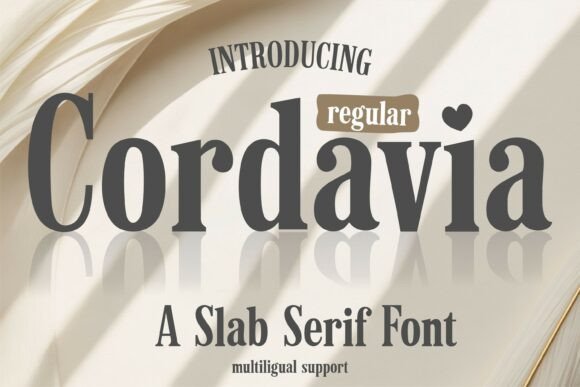
Cordavia Regular is categorized as a slab serif, a classification typically associated with strong, block-like serifs and a sense of stability. However, this specific iteration deviates from the rigid geometry often found in industrial-era slab serifs. The design incorporates soft curves and a subtle vintage flair, resulting in a aesthetic that is less mechanical and more approachable. This hybrid nature makes it distinct from standard geometric slabs like Rockwell or humanist slabs like Clarendon.
A defining characteristic of Cordavia Regular is the heart-shaped dot on the lowercase "i." While this detail adds a layer of personality and warmth, it also serves as a critical evaluation point. In contexts requiring strict neutrality or corporate formality, this stylistic choice may be perceived as too informal. Conversely, in lifestyle branding, children’s products, or artisanal packaging, this detail functions as a memorable visual hook without compromising overall legibility. The font maintains clean lines and professional spacing, ensuring that the decorative element does not hinder reading flow in longer text blocks.
Functional Versatility and Technical Compatibility
Beyond aesthetics, the utility of a font is determined by its technical specifications and software compatibility. Cordavia Regular includes full multilingual support, uppercase and lowercase characters, numbers, and essential symbols. This comprehensive character set is a baseline requirement for international branding or projects involving multiple languages. When evaluating this font against competitors, verifying specific language coverage for niche markets remains a necessary due diligence step.
For the crafting and DIY community, technical integration is often as important as visual style. Cordavia Regular is explicitly designed to work seamlessly with Cricut, Silhouette, Canva, Procreate, Photoshop, and Illustrator. Furthermore, it utilizes PUA (Private Use Area) encoding. This technical feature ensures that all stylistic features and extras are accessible without requiring specialized design software. For users operating within the Cricut Design Space or Silhouette Studio ecosystems, PUA encoding eliminates the friction of copying and pasting glyphs from external character maps, streamlining the production workflow for physical goods like t-shirts and signage.
Distinguishing Regular from Bold Swash Variants
A common point of confusion during the selection process involves distinguishing between the different weights and styles within the Cordavia family. It is imperative to note that only the Cordavia Bold Swash style includes decorative swashes. Cordavia Regular is intentionally clean, professional, and devoid of extended ornamental flourishes.
This distinction significantly impacts purchasing and usage decisions. If a project requires elaborate calligraphy-style tails or dramatic entry and exit strokes for headers, Cordavia Regular will not fulfill that specific need. Users seeking high-impact display typography with extensive ornamentation should evaluate the Bold Swash variant instead. Cordavia Regular is best evaluated as a workhorse typeface suitable for body copy, subheaders, and clean logos where clarity takes precedence over decoration. Understanding this separation prevents mismatched expectations regarding the font's decorative capabilities.
Ideal Use Cases and Strategic Fit
Cordavia Regular performs optimally in scenarios that benefit from a blend of reliability and friendliness. Based on its design metrics, it is particularly well-suited for:
- Lifestyle and Artisanal Branding: The soft curves and vintage undertones resonate well with organic products, handmade goods, and boutique services.
- Packaging Design: The strong slab serifs provide necessary shelf presence, while the friendly tone avoids the coldness of purely industrial typefaces.
- Apparel and Merchandise: The legibility at various sizes makes it effective for t-shirt graphics and tote bags, especially when utilizing cutting machines.
- Inspirational Content: The warm aesthetic supports positive messaging in social media graphics, posters, and home decor prints.
- Signage and Wayfinding: High x-height and open counters contribute to readability at a distance, provided the heart-shaped "i" aligns with the venue's tone.
In these contexts, the font delivers character without sacrificing function. It bridges the gap between decorative display fonts and utilitarian sans-serifs, offering a middle ground for brands that wish to appear established yet accessible.
Considerations and Potential Tradeoffs
No typeface is universally applicable, and Cordavia Regular has specific limitations that must be weighed during evaluation. The primary tradeoff involves its distinctive personality versus neutral versatility. While the heart-shaped "i" and soft serifs are assets in creative and consumer-facing projects, they may be liabilities in highly regulated industries such as finance, law, or medical technology. In these sectors, standard grotesque sans-serifs or traditional transitional serifs often convey the requisite authority and impartiality more effectively.
Additionally, while the font is optimized for digital crafting tools, designers working exclusively in high-end editorial layout should test the font's performance in dense paragraph settings. Slab serifs can sometimes create dark typographic color in long-form text; although Cordavia Regular is designed with openness, proofing at intended print sizes is always recommended. Finally, users must remember that the Regular weight lacks swashes. Relying solely on this variant for a project that demands varied typographic hierarchy may result in a static design. Pairing Cordavia Regular with a complementary script or the Bold Swash variant is often necessary to achieve dynamic visual contrast.
Making the Final Selection Decision
Determining whether Cordavia Regular is the correct choice requires aligning its attributes with specific project goals. If the objective is to communicate warmth, vintage charm, or approachable professionalism across both digital and physical mediums, this typeface is a strong candidate. Its PUA encoding and broad software compatibility further solidify its value for makers and small business owners who require efficiency alongside aesthetics.
However, if the project demands strict corporate neutrality, extensive ornamental swashes in the regular weight, or ultra-condensed spacing for data-heavy environments, alternative typefaces should be explored. By clearly defining the emotional tone and technical requirements of the project before selection, designers can leverage Cordavia Regular’s unique blend of classic elegance and friendly detail to create effective, resonant communications. Ultimately, successful typography selection is not about finding the "best" font, but rather identifying the tool that most accurately translates the intended message to the target audience.