Lindery: A Futuristic Display Font for Bold Design
In the crowded landscape of digital typography, finding a typeface that genuinely stops the scroll is a rare achievement. Lindery distinguishes itself not through subtle serifs or traditional proportions, but through a radical reimagining of letterform structure. Defined by its signature three-line stroke design, this display typeface offers a visual texture that feels simultaneously engineered and artistic. For designers, marketers, and creators seeking to communicate innovation, Lindery provides an immediate aesthetic shorthand for futurism without sacrificing legibility in headline applications.
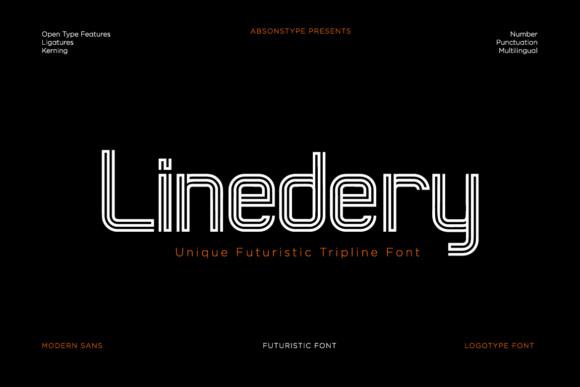
The core appeal of Lindery lies in its triple-line construction. Rather than relying on solid fills or standard outlines, each character is built from three distinct parallel strokes. This creates an inherent sense of depth and movement, transforming static text into something that appears kinetic. When applied correctly, this structural uniqueness allows the font to carry the weight of a project’s visual identity, making it an invaluable asset for brands and projects that need to signal forward-thinking creativity.
Deconstructing the Triple-Line Aesthetic
To use Lindery effectively, one must understand how its geometry interacts with space. The three-line stroke is not merely a decorative effect; it is the fundamental architecture of the typeface. This means that negative space plays as significant a role as the positive forms. When setting text in Lindery, the gaps between the lines create a rhythm that guides the eye horizontally. This optical flow makes the typeface exceptionally strong for wide-format layouts where you want to encourage reading from left to right.
Because of this intricate internal detailing, Lindery performs best at larger sizes. It is strictly a display typeface, meaning it is optimized for headlines, logos, and short bursts of impactful copy. Attempting to use it for body text or small captions will result in visual noise and reduced readability. However, when given room to breathe at 48pt or above, the precision of the letterforms shines. The triple strokes maintain their integrity, creating a crisp, high-tech appearance that feels deliberate rather than accidental.
Color and Contrast Strategies
The multi-stroke nature of Lindery opens up unique opportunities for color treatment that solid fonts cannot offer. Designers can leverage the separation between lines to introduce gradient effects or dual-tone coloring. For example, applying a subtle shift in hue across the three lines can enhance the perception of depth, making the letters appear three-dimensional. Alternatively, using a high-contrast color against a dark background emphasizes the futuristic essence of the font, mimicking neon signage or digital interfaces.
When working with complex backgrounds, ensure sufficient contrast remains between the strokes and the canvas. Because the lines are thinner than a standard bold weight, they can disappear against busy photography or textured patterns. A practical approach is to place Lindery over solid color blocks or heavily blurred images, allowing the typographic detail to remain the focal point. This restraint ensures the innovation of the typeface communicates clarity rather than confusion.
Practical Applications Across Industries
Lindery’s bold, futuristic character makes it versatile across several creative sectors, provided the application aligns with the brand's voice. Its utility extends beyond generic "tech" aesthetics into specific niches where differentiation is key.
- Technology and SaaS Branding: For startups and software companies, Lindery signals cutting-edge development. Use it for product names or primary value propositions on landing pages. The structured lines suggest code, circuitry, and systematic thinking, reinforcing trust in technical precision.
- Fashion and Streetwear: In apparel design, typography often serves as the primary graphic element. Lindery’s architectural quality works well on garment tags, oversized t-shirt prints, and lookbook headers. It bridges the gap between industrial utility and high-fashion experimentation.
- Event and Festival Posters: Music festivals, art exhibitions, and gaming conventions require visuals that promise an immersive experience. The kinetic energy of the triple-line strokes captures the excitement of live events and digital entertainment, standing out in social media feeds and physical signage alike.
- Editorial and Publishing: For magazines or blogs covering science fiction, futurism, or design culture, Lindery serves as an excellent masthead or pull-quote font. It sets a thematic tone immediately, preparing the reader for content that explores new ideas or speculative futures.
Adapting for Digital and Print Contexts
While Lindery is inherently digital in spirit, its translation to print requires specific technical considerations. On screens, particularly high-resolution displays, the three lines render with pixel-perfect sharpness. In print, however, ink spread can sometimes close the gaps between the strokes, especially on uncoated papers. To preserve the distinctive triple-line effect in physical media, opt for coated stocks or increase the tracking slightly to compensate for potential ink bleed. Always request a physical proof before committing to a large print run to ensure the delicate balance of the letterforms holds up at the intended size.
For web implementation, consider loading Lindery as a variable font if available, or ensure robust fallback options. Since it is a display face, pair it with a highly legible sans-serif for body copy. Fonts like Inter, Roboto, or Helvetica Now provide a neutral foundation that lets Lindery’s personality dominate the hierarchy without competing for attention. This pairing strategy maintains usability while delivering the desired creative impact.
Maintaining Clarity in Experimental Design
A common pitfall when using distinctive display fonts is over-styling. Lindery already possesses significant visual complexity due to its stroke construction. Adding excessive drop shadows, outer glows, or distortion effects often muddies the design rather than enhancing it. The most effective uses of Lindery rely on restraint. Let the typeface do the heavy lifting. If you need to emphasize a word, consider scaling it up or changing the color rather than adding decorative effects that clash with the existing line work.
Consistency is equally important for branding. If you choose Lindery for your logo or primary headlines, establish clear guidelines for its usage. Define minimum sizes, safe zones, and approved color palettes. This prevents the typeface from being misused in contexts where it loses its impact. By treating Lindery as a specialized tool rather than a universal solution, you preserve its power to captivate audiences. It is a font that dares to stand out, but it stands out best when supported by a thoughtful, organized design system.
Balancing Innovation with Accessibility
Creative expression should never completely override function. While Lindery is designed for aesthetic impact, accessibility remains a priority for professional designers. Ensure that any text set in Lindery meets WCAG contrast standards against its background. Avoid using the font for critical navigation elements or essential instructions where instant recognition is necessary. Reserve it for moments of emphasis and expression. By confining Lindery to decorative and headline roles, you satisfy both the desire for a futuristic aesthetic and the requirement for inclusive, user-friendly design.
Ultimately, Lindery offers a fresh vocabulary for visual communication. It challenges the monotony of standard geometric sans-serifs by introducing a layer of crafted complexity. Whether you are designing a poster for a cyberpunk film, rebranding a tech consultancy, or creating cover art for an electronic album, this typeface provides a distinctively modern edge. Its success lies in its ability to be simultaneously structured and expressive, proving that futuristic design can be both bold and precisely controlled.