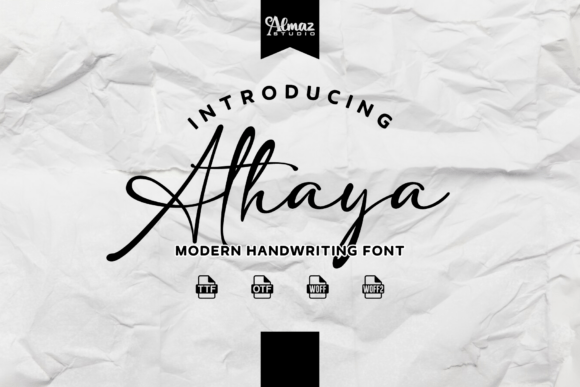
Athaya: Elevating Design with Authentic Script
In a digital landscape often dominated by rigid grids and uniform sans serif typefaces, finding a font that feels genuinely human can transform a project from sterile to soulful. Athaya is a script and handwriting typeface designed to bridge this gap, offering the fluidity of natural cursive writing combined with the reliability required for professional design work. Unlike standard system fonts, Athaya mimics the organic imperfections and rhythmic flow of a pen moving across paper. This authenticity is precisely what makes it such a valuable asset for designers, marketers, and business owners looking to inject warmth and personality into their visual communications.
The visual character of Athaya sits comfortably between formal calligraphy and casual modern handwriting. It avoids the overly ornate flourishes that can make some script fonts difficult to read, yet it possesses enough elegance to feel premium. The stroke weight varies naturally, suggesting the pressure changes of a real hand, while the letter connections maintain a smooth, continuous line. This balance allows Athaya to function as both a decorative element and a legible display font. Whether you are crafting a wedding invitation or designing packaging for an artisanal product, the typeface evokes a sense of sophistication without sacrificing approachability. It feels personal, intentional, and distinctly creative.
Strategic Applications Across Branding and Editorial
Versatility is one of Athaya’s strongest attributes, but knowing where to deploy it is key to maintaining design integrity. As a display font, it shines brightest in contexts where emotional connection drives engagement. For brand identity, Athaya works exceptionally well in logo design for businesses that want to signal craftsmanship, care, or luxury. Think boutique skincare lines, independent coffee roasters, or creative agencies. In these scenarios, the font acts as a visual shorthand for "handmade" or "personal service," instantly differentiating the brand from corporate competitors using generic typography.
In the realm of editorial design and publishing, Athaya serves as an excellent tool for establishing hierarchy. While it is not suitable for body text due to its intricate forms, it creates stunning contrast when paired with clean serif or sans serif fonts for chapter titles, pull quotes, or magazine headers. This juxtaposition guides the reader’s eye and breaks up dense blocks of text, making the content more digestible and visually engaging. For bloggers and content creators, using Athaya in social media graphics or Pinterest pins can significantly increase stop-rate; the human touch of handwritten typography tends to perform better in feeds saturated with bold, blocky text because it feels like a personal note rather than an advertisement.
Packaging design presents another prime opportunity for this typeface. On physical products, texture and tactility matter. Athaya’s organic strokes complement matte finishes, textured papers, and minimalist layouts. When used on labels, tags, or unboxing experiences, it reinforces the narrative of quality and attention to detail. However, restraint is necessary. Using Athaya for every element on a package will dilute its impact and harm readability. Reserve it for the brand name, flavor descriptors, or special messages, allowing negative space and simpler supporting fonts to let the script breathe.
The Psychology of Handwritten Typography
Choosing Athaya is not merely an aesthetic decision; it is a strategic communication choice. Typography carries subconscious associations, and script fonts like Athaya trigger specific psychological responses. Research in design psychology suggests that handwritten styles are perceived as more sincere, warm, and trustworthy compared to mechanical typefaces. When a customer sees Athaya on a thank-you card or a website header, they are primed to feel a personal connection to the sender. This is invaluable for small business owners and entrepreneurs building relationships rather than just transactions.
Furthermore, Athaya influences perceived value. In marketing, we often see that "effortful" aesthetics signal higher quality. Because the font mimics the time-intensive process of hand-lettering, it subtly implies that the product or service behind it was created with similar care. This perception of effort translates to justification for premium pricing in luxury markets. However, this effect relies entirely on execution. If Athaya is stretched, distorted, or placed against a busy background, the illusion of craftsmanship breaks, and the design looks amateurish. The font demands respect for its form to deliver its psychological benefits effectively.
Practical Guidelines for Pairing and Implementation
To get the most out of Athaya, you must treat it as a specialist tool within your broader typographic system. Successful font pairing is about contrast and harmony. Since Athaya has high visual complexity and strong personality, pair it with neutral, stable typefaces. A geometric sans serif like Montserrat or a classic transitional serif like Merriweather provides the necessary anchor. Avoid pairing Athaya with other script or highly decorative fonts; competing personalities create visual noise and confusion. Let Athaya be the star, and use your secondary fonts to handle the heavy lifting of information delivery.
Readability should always dictate usage. Even though Athaya is more legible than many vintage scripts, it still requires adequate sizing and spacing. Never use it below 24pt in print or equivalent pixels on screen. Tight tracking (letter-spacing) is generally detrimental to script fonts because it breaks the natural connections between letters; instead, opt for default or slightly loose tracking to preserve flow. Always test your designs at actual size before finalizing. What looks elegant on a 27-inch monitor may become illegible on a mobile device or a business card. Responsive web design requires particular vigilance here; consider setting breakpoints where Athaya swaps to a simpler font on smaller screens to maintain user experience.
Evaluating Fit and Licensing
Before committing Athaya to a project, conduct a honest audit of your brand voice. Does your audience value tradition, warmth, and artistry? Or do they prioritize tech-forward efficiency and minimalism? Athaya aligns with the former. If your brand is clinical, futuristic, or strictly corporate, this typeface may send mixed signals. Test the font in context—mock up a real Instagram post, a product label, or a website hero section—rather than judging it in isolation. Seeing it interact with your photography, color palette, and copy is the only way to gauge true fit.
Finally, never overlook the legal and ethical aspects of using premium fonts. Athaya is a creative asset, and respecting intellectual property is part of professional practice. Review the licensing terms carefully. Personal licenses typically cover hobby projects and non-commercial use, while commercial licenses are required for any business application, including client work, products for sale, and monetized content. Some licenses have tiered pricing based on revenue or impression counts. Ensuring you have the correct license protects you legally and supports the type designer who crafted the tool. Investing in the proper commercial license also grants you access to full character sets, alternates, and ligatures that elevate the final design beyond what free alternatives can offer.
Ultimately, Athaya offers a pathway to more expressive, human-centered design. By understanding its strengths, respecting its limitations, and applying it with strategic intent, you can leverage this beautiful script to build deeper connections and create work that resonates on an emotional level. Whether you are refining a brand identity or adding flair to a personal project, Athaya brings the timeless appeal of handwriting into the modern creative workflow.