Elevating Brand Identity and Editorial Design with Vintage Signature Typography
In the competitive landscape of visual communication, typography serves as the silent ambassador of brand personality. While clean sans-serifs dominate digital interfaces for their readability, there remains a profound demand for typefaces that convey emotion, heritage, and bespoke craftsmanship. Vintage Signature occupies this specific niche, functioning not merely as a collection of glyphs but as a strategic design asset. This luxury calligraphy font bridges the gap between historical penmanship and contemporary branding needs, offering designers and business owners a tool to infuse projects with tangible sophistication.
Understanding the utility of Vintage Signature requires looking beyond its aesthetic appeal to examine its structural integrity, technical accessibility, and practical applications across various industries. For professionals ranging from wedding stationers to boutique marketers, the choice of this typeface represents a deliberate move toward personalized, high-touch visual storytelling.
The Anatomy of Refined Calligraphic Form
To leverage Vintage Signature effectively, one must first understand the design principles that distinguish it from standard script fonts. Many digital scripts suffer from mechanical repetition or poor spacing, which breaks the illusion of hand-lettering. Vintage Signature is engineered to avoid these pitfalls through specific anatomical choices that prioritize rhythm and flow.
Sweeping Curves and Organic Balance
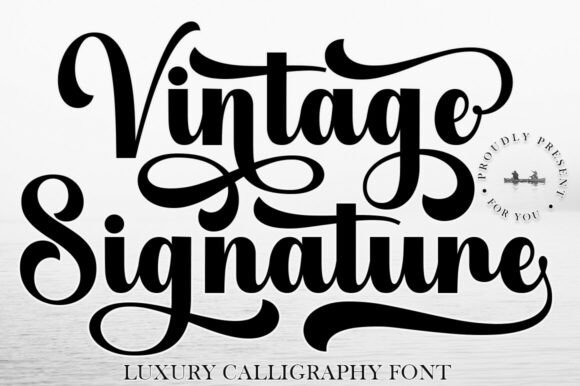
The defining characteristic of this typeface is its sweeping curves. Unlike rigid geometric scripts, the letterforms in Vintage Signature exhibit natural variation in stroke width and curvature. This mimics the pressure sensitivity of a physical nib or brush, creating a sense of movement even in static print. The well-balanced forms ensure that no single character overpowers its neighbors, maintaining a harmonious baseline that is crucial for legibility at smaller sizes. This organic balance radiates grace, making each word appear as though it were hand-penned with intentional purpose rather than generated by an algorithm.
Feminine Edge and Typographic Rhythm
Typography carries gendered associations that influence consumer perception. Vintage Signature possesses a distinctly feminine edge, achieved through soft terminals, open counters, and fluid connections. However, this femininity is tempered by a refined rhythm that prevents the design from appearing overly saccharine or juvenile. The cadence of the letters creates a visual tempo that guides the reader’s eye smoothly across the line. This sophisticated rhythm transforms ordinary words into elegant expressions, allowing the text to function as both information and ornamentation simultaneously.
Technical Accessibility Through PUA Encoding
A common barrier to entry for luxury script fonts is the difficulty of accessing alternate characters and swashes. Historically, designers needed specialized software like Adobe Illustrator or InDesign to utilize OpenType features. Vintage Signature addresses this limitation through comprehensive PUA (Private Use Area) encoding.
Democratizing High-End Design
PUA encoding maps special characters, ligatures, and decorative elements to Unicode slots that are accessible via standard character map utilities on both Windows and macOS. This technical inclusion has significant practical implications:
- Software Agnostic Workflow: Users can access all stylistic alternates in basic design tools like Canva, Cricut Design Space, Silhouette Studio, and Microsoft Word.
- Efficiency in Production: Designers do not need to switch between applications to add flourishes, streamlining the production pipeline for custom stationery and labels.
- Customization Without Expertise: Small business owners and hobbyists can achieve professional-grade typographic hierarchy without mastering complex glyph panels.
This accessibility ensures that the "signature of classic style" promised by the font is attainable regardless of the user's technical proficiency or software budget. It transforms what was once an elite typographic feature into a standard utility for creators.
Strategic Applications Across Industries
The versatility of Vintage Signature lies in its ability to adapt to different contexts while maintaining its core identity. Its application extends far beyond simple decoration; it serves functional roles in marketing, event planning, and product differentiation.
Wedding Stationery and Event Branding
In the wedding industry, typography sets the tone for the entire event. Vintage Signature is particularly effective for invitation suites where the goal is to communicate formality and intimacy. The hand-penned aesthetic suggests that the hosts have invested personal care into the guest experience. When used for names, dates, and venue details, the font elevates the perceived value of the stationery. Pairing this script with a minimalist serif or a clean sans-serif for body text creates a classic typographic contrast that ensures readability while highlighting key information.
Boutique Branding and Product Packaging
For artisanal brands, beauty products, and luxury boutiques, packaging is a primary touchpoint. Vintage Signature excels in product labeling where space is limited but impact must be high. The distinctiveness of the letterforms helps products stand out on crowded shelves against competitors using generic typography. On cosmetic jars, perfume boxes, or artisan food labels, the font conveys heritage and quality. It signals to the consumer that the product inside is crafted rather than mass-produced. The feminine edge aligns naturally with beauty and wellness sectors, while the timeless sophistication appeals to heritage menswear or unisex luxury goods when used sparingly.
Editorial Headers and Digital Content
In editorial design, whether for magazines, blogs, or social media graphics, headers serve as entry points for readers. Vintage Signature provides a strong visual anchor that breaks up dense blocks of body copy. Its artistic flair makes it ideal for pull quotes, section dividers, and cover titles. In digital environments, where screen resolution can sometimes degrade fine details, the well-balanced forms of this typeface maintain clarity better than thinner, more erratic scripts. This makes it a viable option for web headers and Instagram stories where elegance must coexist with digital legibility constraints.
Best Practices for Implementation and Pairing
Owning a luxury font does not guarantee a luxury result; execution matters. To maximize the effectiveness of Vintage Signature, designers should adhere to established typographic best practices.
The Art of Font Pairing
Vintage Signature is a display typeface designed to command attention. It should rarely be used for extended body text. Successful implementation relies on pairing it with supportive typefaces that provide contrast and stability.
- Geometric Sans-Serifs: Fonts like Montserrat or Futura offer a modern counterpoint to the vintage curves, grounding the design in contemporary aesthetics.
- Transitional Serifs: Typefaces such as Baskerville or Playfair Display reinforce the traditional feel without competing for attention, suitable for ultra-formal invitations.
- Monospaced Fonts: For a trendy, editorial look, pairing the flowing script with a structured monospace font creates an intriguing tension between organic and mechanical.
Hierarchy and Negative Space
Because Vintage Signature features sweeping curves and decorative elements, it requires generous negative space. Crowding the letterforms diminishes their elegance and reduces legibility. Designers should treat the whitespace around the script as an active part of the composition. Furthermore, hierarchy is essential; use the script for the most critical element only (e.g., the couple's name or the product title). Secondary information should be set in simpler faces to allow the signature font to breathe and perform its role as a focal point.
Color and Texture Considerations
The intricate details of calligraphy fonts interact uniquely with color and texture. High-contrast combinations, such as gold foil on dark cardstock or white ink on kraft paper, enhance the luxurious feel. However, when using textured backgrounds, ensure the font weight is sufficient to prevent the texture from breaking up the letterforms. In digital formats, avoid placing the script over busy photographic backgrounds without a solid overlay or drop shadow, as the fine lines can easily get lost.
The Psychological Impact of Handwritten Aesthetics
Beyond aesthetics and technical specs, the choice of Vintage Signature taps into psychological responses associated with handwriting. In an increasingly automated world, consumers crave authenticity and human connection. Research in consumer psychology suggests that handwritten-style typography can increase perceptions of sincerity, effort, and exclusivity.
When a brand utilizes a font that feels hand-penned with purpose, it subconsciously communicates that a human being was involved in the creation process. This is particularly valuable for service-based businesses and artisans where trust is paramount. The "vintage" aspect triggers nostalgia, associating the brand with positive memories of the past, quality craftsmanship, and slower, more deliberate lifestyles. By integrating Vintage Signature into a visual identity, businesses are not just selecting a pretty font; they are leveraging these deep-seated cognitive associations to build stronger emotional bonds with their audience.
Maintaining Timelessness in Trend-Cycles
Design trends are cyclical, but true style endures. While maximalist and brutalist trends may fluctuate, the appreciation for refined calligraphy remains constant because it is rooted in centuries of typographic history. Vintage Signature avoids the trap of being overly trendy by adhering to classical proportions rather than faddish distortions. Its sweeping curves and balanced forms are derived from traditional copperplate and Spencerian influences, updated for modern sensibilities.
This foundation in historical precedent ensures that designs created today will not look dated in five years. For businesses investing in long-term branding assets, this longevity is a critical return on investment. Unlike novelty fonts that define a specific moment in time, Vintage Signature offers a flexible canvas that can evolve with a brand while retaining its core elegance. It serves as a stable anchor in a visual identity system, providing consistency even as other design elements refresh and change.